
Rotterdam – Last week, throughput figures for the Port of Rotterdam covering the first nine months of 2026 were released. Once again, the results paint a highly disappointing picture. Unlike some competing ports, Rotterdam has been unable to escape the downward trend affecting large parts of the maritime sector.
375 words – 2 minutes to read
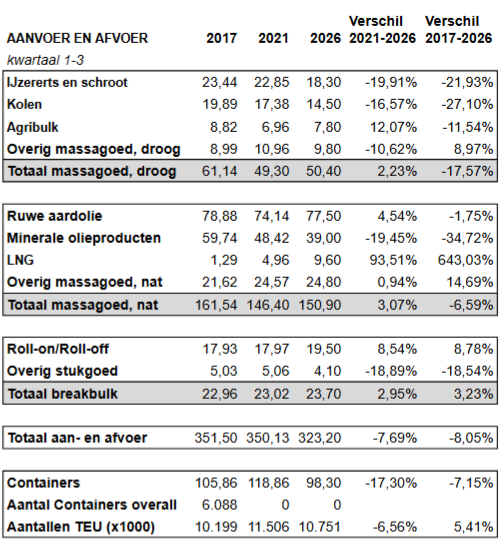
Despite the significant growth in global trade, the Port of Rotterdam has lost considerable ground on almost every front over the past five years and decade. Although 2021 was an exceptionally difficult year due to the COVID-19 pandemic, throughput figures for the first three quarters of 2026 are still alarming, even when compared with that period. Click on the tabel or the following link to see the Havendata dataset.
Infrastructure Remains a Key Concern
According to Boudewijn Siemons, CEO of the Port of Rotterdam Authority, there is little reason for alarm. At the same time, he has urged key stakeholders, including the Municipality of Rotterdam and the Dutch national government, to continue investing in future-proof road, rail and inland waterway connections. “Reliable infrastructure forms the foundation for economic growth and a resilient supply chain,” Siemons stated.
While Maasvlakte 2, developed between 2008 and 2013, appears to have finally reached full momentum after several cautious years and is now delivering tangible benefits, the remainder of the Rotterdam port complex is losing market share. According to observers, the decline has been so substantial that it has virtually offset the gains generated by Maasvlakte 2 over the past decade.
Only three cargo segments recorded growth in tonnage during the last ten years:
- Other dry bulk cargo
- LNG (Liquefied Natural Gas)
- Roll-on/Roll-off (RoRo) traffic
Antwerp Closing In on Top Position
Next week, the Port of Antwerp-Bruges is expected to publish its throughput figures. Many industry stakeholders are watching closely. Despite disruptions caused by pension reform strikes and an oil spill in the Deurganck Dock earlier this year, market expectations remain that Antwerp delivered another strong performance during the third quarter.
Although this may not be sufficient to fully compensate for the losses caused by the strikes and the oil spill, many analysts expect Antwerp to definitively overtake Rotterdam after the fourth quarter and assume the title of Europe’s largest container port.
The anticipated shift would mark a historic milestone in the competitive relationship between the two ports, which have long dominated the European container and logistics landscape.