
Rotterdam – Maasvlakte 1 and Maasvlakte 2 are increasingly at risk of becoming victims of their own success. According to critics, several new terminals on Maasvlakte 2 are failing to comply with the agreed modal split target of approximately 45 percent transport by inland waterways. At the same time, terminal operators appear reluctant to invest in attractive public transport options for their employees. This is remarkable, considering that these same companies regularly express concerns about the accessibility of the Port of Rotterdam.
767 words – 4 minutes read
Maasvlakte 1 and Maasvlakte 2
The Port of Rotterdam has expanded significantly since the 1970s. Between 1970 and 1974, Maasvlakte 1 was constructed at record speed, creating more than 3,371 hectares (33.71 km²) of new port and industrial land. Between 2008 and 2013, a further 2,000 hectares (20 km²) was added with the development of Maasvlakte 2. As a result, the port area grew dramatically over a period of fifty years.
The supporting infrastructure, however, did not expand at the same pace. While the port itself continued to grow, access routes to Maasvlakte remained largely unchanged. Traffic is still highly dependent on the aging Suurhoff Bridge, which has repeatedly made headlines since its commissioning due to numerous collisions, technical failures and structural issues.
This is despite the fact that the Transumo A15 project group already recommended the construction of the so-called Oranje Tunnel in 2009. That proposal was ultimately shelved. Instead, authorities opted for the Maasdelta Tunnel between Vlaardingen and Rozenburg, approximately fifteen kilometres inland. This toll tunnel officially opened on 7 December 2024.
Modal Split
One of the key reasons why no major investments were made in additional road capacity at the time was the expectation that a large share of freight transport would be handled through alternative modes of transport. Within the Transumo A15 project, inland shipping, rail transport and pipelines were assigned a prominent role in ensuring that the Port of Rotterdam remained both accessible and sustainable.
The underlying assumption was that terminal operators on Maasvlakte 2 would transport at least 45 percent of their containers to the hinterland by inland vessel. If that target was achieved, existing road infrastructure was expected to provide sufficient capacity. However, the Port of Rotterdam Authority has not adequately enforced these agreements. As a result, the share of freight transported by road has become larger than anticipated, placing increasing pressure on the accessibility of Maasvlakte.
It is worth noting that in 2009 projections assumed container throughput in Rotterdam would triple from approximately 11 million TEU in 2009 to 33 million TEU by 2033. Fortunately, that forecast never materialized. Following the record year of 2021, container throughput has actually declined in recent years, as illustrated by the Havendata chart below.
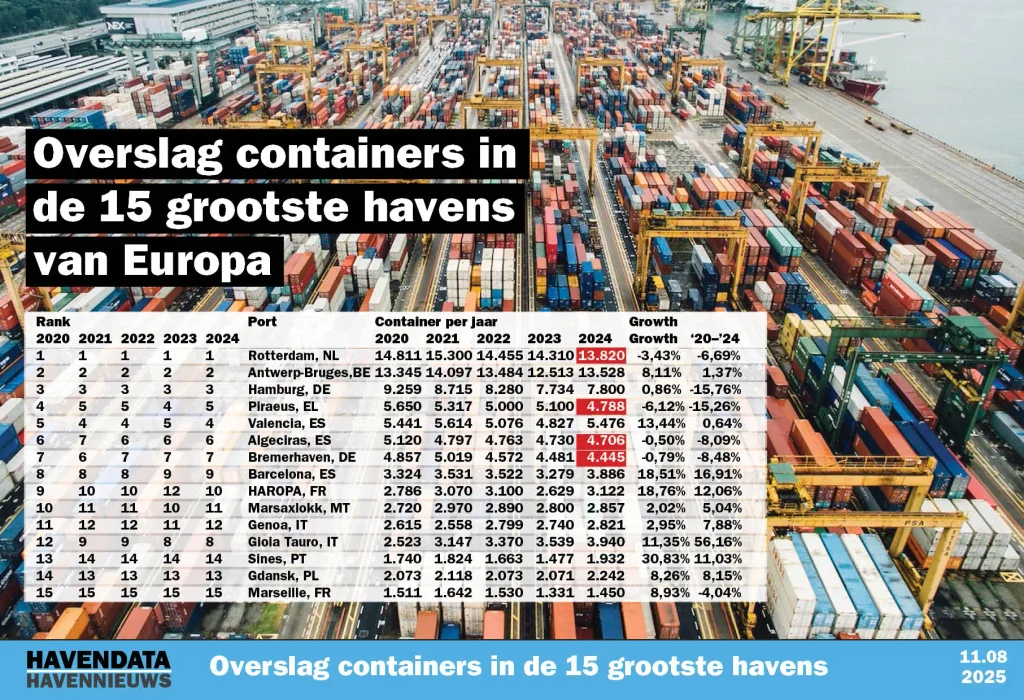
Container throughput in the 15 largest ports in Europe
Employees Commuting by Car
In addition to freight traffic, daily commuting is also contributing significantly to congestion on Maasvlakte. Thousands of employees travel to and from work by car every day. The Transumo A15 project group anticipated this issue and therefore proposed a form of congestion charging in 2009.
Under the proposal, freight vehicles would have been required to pay a fee to enter Maasvlakte during peak traffic hours. There was even discussion of extending the toll to all vehicles. Trucks would have paid €5 per 12-hour period, while passenger cars would have been charged €2 per 12-hour period for access to Maasvlakte. Cars carrying more than one occupant would have been exempt from the toll.
Waterborne public transport was also expected to contribute to improved accessibility. Public transport services would have been exempt from toll charges, and planners hoped that ferry services could play a role similar to those in Hamburg, where ferries are an integral part of daily commuting for port workers.
Unfortunately, both the Port of Rotterdam Authority and Deltalinqs ultimately withdrew their support for this concept, and ferry services to Maasvlakte were discontinued in 2022. Efforts are now being made to encourage carpooling and public transport use through financial incentives. However, the results have so far been disappointing, and unless companies become more actively involved, this initiative is also likely to be abandoned.
See: https://havennieuws.nl/platform-reizennaardehaven-nl-groot-succes-vanwege-amerikaanse-oorloghandelingen/
Learning from Other Port Cities
During European Mobility Week, Havennieuws visited Hamburg as well as other major port cities including Gdańsk, Copenhagen and Antwerp to study how these locations maintain accessibility within their port areas. The visit examined a wide range of solutions, from ferry services and bus networks to intelligent traffic management systems.
Unfortunately, both Deltalinqs and the Port of Rotterdam Authority declined to participate in this international exchange of knowledge and best practices.