
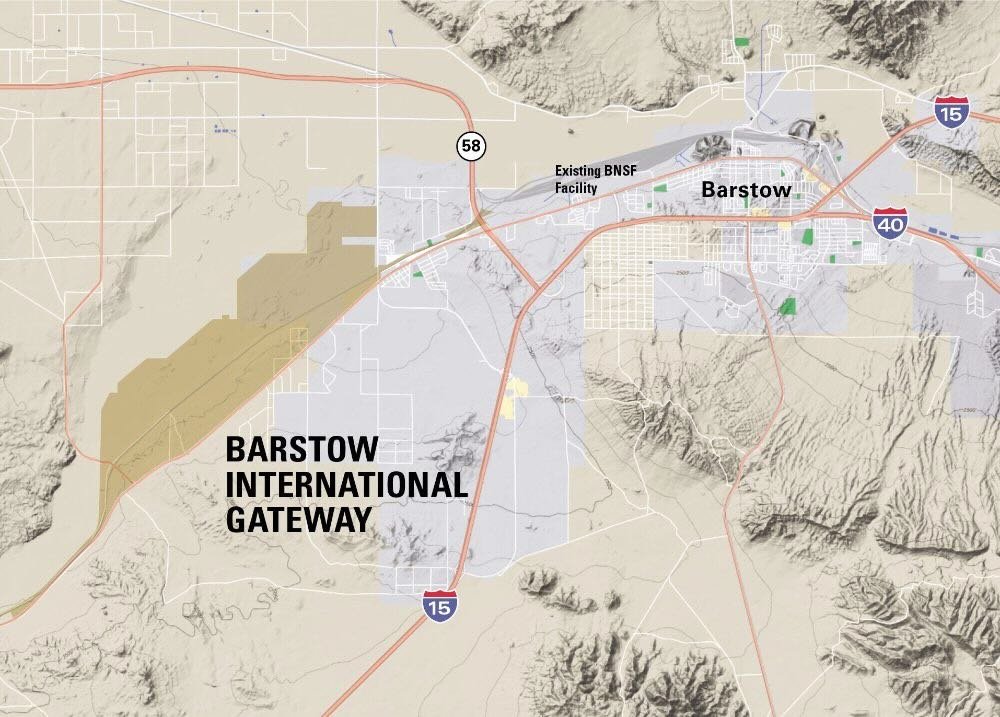
Barstow, California – In June, the Barstow City Council approved the development of the Barstow International Gateway (BIG), a transformative logistics project led by BNSF Railway. Located west of Barstow on approximately 185 kilometres northeast of Los Angeles and 260 km southwest of Las Vegas, Barstow is a city of around 22,000 residents that has long served as a strategic transportation crossroads at the intersection of major highways and key freight rail corridors. The city is served by BNSF Railway and Amtrak services, while the future Brightline West high-speed rail connection between Los Angeles and Las Vegas with a stop at just 40 minutes from Barstow will further strengthen its role as a transport and passengers hub.
560 words | 3 min read
BIG: A $4 Billion Logistics Investment
The Barstow International Gateway represents a private BNSF investment of approximately $4 billion and will transform more than 18 square kilometres of largely vacant land west of Barstow into one of North America’s most advanced inland logistics hubs.
The development will include:
- A modern rail yard;
- An intermodal terminal;
- Large-scale transload and warehousing facilities;
- Zero-emission cargo-handling equipment.
Once fully operational, BIG is expected to process around 2,000 containers per day by 2040. By shifting container movements from trucks to rail, the project could remove thousands of truck journeys from greater LA highways, helping to reduce congestion, lower emissions, and improve supply chain resilience.
According to project estimates, BIG will support approximately 62,000 construction-related jobs and 15,000 long-term operational positions, including direct, indirect, and induced employment throughout San Bernardino County. The project is also expected to strengthen the competitive position of the Ports of Los Angeles and Long Beach by creating the first fully integrated rail and transload complex within roughly 210 kilometres of the ports.
Creating a New Inland Freight Corridor
Containers arriving at the Ports of Los Angeles and Long Beach will move directly from ships onto trains via the Alameda Corridor before continuing on the BNSF mainline to Barstow. At BIG, containers will be sorted, consolidated, and assembled into double stack long-distance trains destined for markets across the United States. Westbound freight will also be consolidated at the facility, enabling agricultural products, consumer goods, and industrial cargo to move efficiently back toward California’s ports and by ships to the rest of the world. This inland-port model reduces pressure on valuable waterfront land, improves cargo throughput, and allows ports to focus on their core activities: handling vessels and moving cargo quickly.
A Blueprint for European Ports?
The most important lesson for Europe is not the size of BIG but its concept. Rather than expanding logistics operations directly next to crowded seaports or even further away from freight’s final hinterland destination, BNSF is moving container sorting, storage, and train assembly activities inland to a location where land is abundant and congestion is limited.
For ports such as Rotterdam, Antwerp-Bruges, Hamburg, and Le Havre, the Barstow model demonstrates how inland logistics hubs can increase capacity without requiring major waterfront expansion. By combining rail, warehousing, and transloading activities in strategically located inland terminals, ports can reduce truck traffic, improve sustainability, and create additional growth opportunities far beyond the quayside.
As freight volumes continue to increase and pressure on European transport networks grows, projects such as BIG offer a compelling example of how ports can expand their hinterland reach while improving efficiency, resilience, and environmental performance.